

Author: admin

  • How to Reduce Screen Time Without the Meltdown: An Independent Play Blueprint for Busy Moms

    How to Reduce Screen Time Without the Meltdown: An Independent Play Blueprint for Busy Moms

    If screen time is your current survival tool — no judgment. But there’s a way out that doesn’t involve a battle.

    The modern “busy mom” exists in a state of constant task-switching, often wondering how to build independent play stamina in a world dominated by digital distractions. You are likely trying to answer a work email while a toddler asks for a snack, or attempting to fold a mountain of laundry while a tablet blares repetitive cartoons in the background. In these moments of high stress, we often reach for the screen as a “digital babysitter.” It feels like the only viable tool to guarantee a moment of quiet so we can simply function.

    However, many parents notice a frustrating and predictable pattern: the second the screen turns off, a “post-tablet meltdown” begins. If you’ve ever wondered why your child goes from “calm” in front of an iPad to a full-blown tantrum the moment it’s put away, the answer isn’t that your child is “spoiled.” It’s biology. By shifting our focus toward independent play stamina, we can move away from passive consumption and toward a regulated, focused child who can thrive without a screen.

    I’ve also put together a free printable Screen Time Transition Tracker you can download at the end — print it, stick it on the fridge, and fill it in together each day. Let’s get into it.
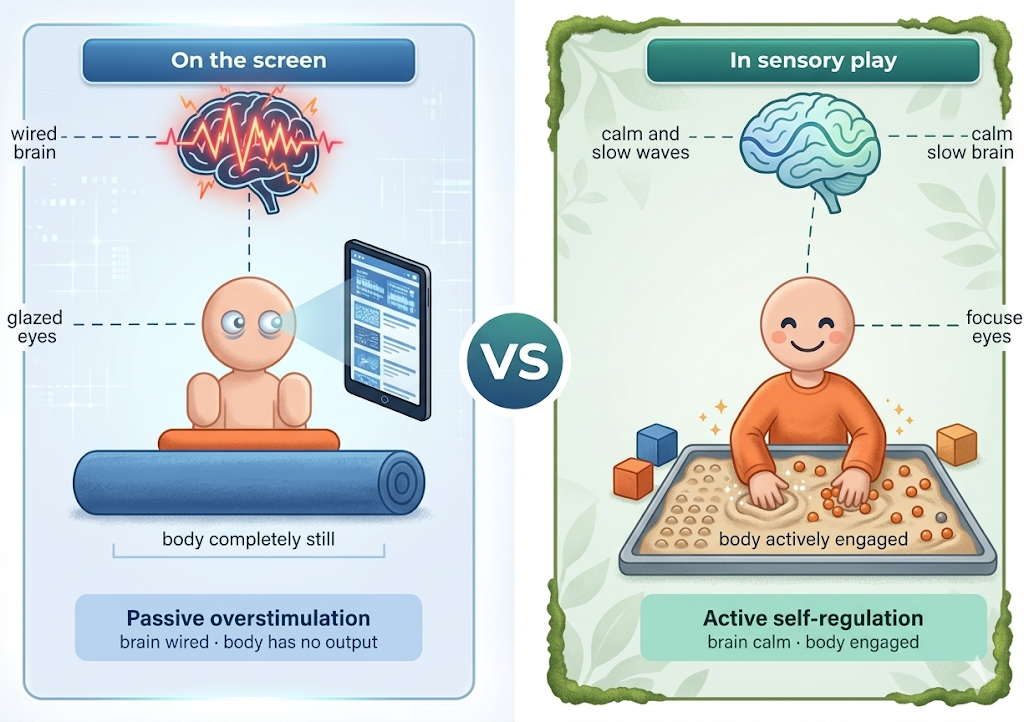
    The Science of the “Digital Pacifier” vs. Active Engagement

    To understand how to build independent play stamina, we first have to understand what a screen does to a developing brain. When a child watches fast-paced digital content, their nervous system is in a state of passive overstimulation. Their eyes are receiving rapid-fire visual hits of dopamine, but their body is completely still.

    This creates a “top-heavy” energy. Their brain is wired, but their physical system has had no output. When the screen turns off, that built-up sensory energy has nowhere to go, resulting in a nervous system crash.

    True independent play is the opposite. It is an active state of flow. When a child engages with tactile materials—like water, sand, or blocks—they are regulating their own heart rate and sensory input. They aren’t just “staying busy”; they are practicing the cognitive skill of self-occupation. This is the “Blueprint” for reclaiming your morning productivity.


    The Regulation Cheat Sheet: Matching the Task to the Mood
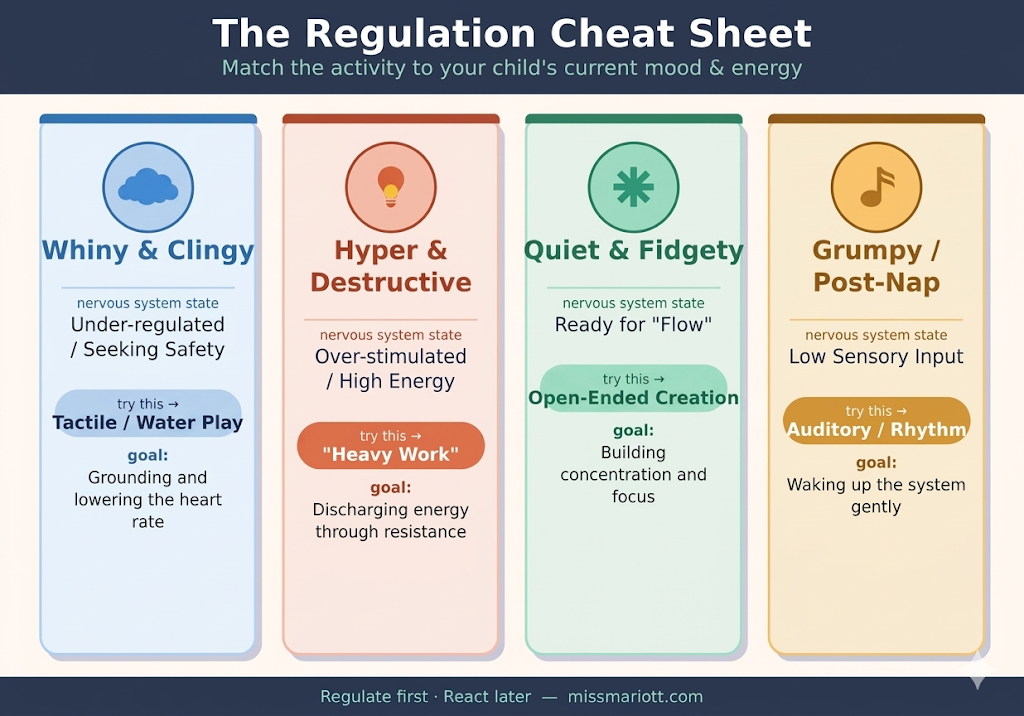
    One of the biggest mistakes we make is offering the wrong activity for the child’s current energy level. If a child is already “bouncing off the walls,” a quiet coloring book will feel like a cage. Use this table to match the sensory input to their current state.

    If your child is…The Nervous System StateYou should provide…Strategic Goal
    Whiny & ClingyUnder-regulated/Seeking SafetyTactile/Water PlayGrounding and lowering the heart rate.
    Hyper/DestructiveOver-stimulated/High Energy“Heavy Work”Discharging energy through resistance.
    Quiet/FidgetyReady for “Flow”Open-Ended CreationBuilding concentration and focus.
    Grumpy/Post-NapLow Sensory InputAuditory/RhythmWaking up the system gently.

    Pillar 1: The Power of Co-Regulation (Regulate First, React Later)

    In the world of gentle parenting, there is a powerful mantra: Regulate first, react later. As moms, we often try to “toss” an activity at a child while we are already halfway out the room to start the dishes. This triggers a separation anxiety response.

    The 5-Minute Anchor Technique

    Before you expect your child to play for 20 minutes alone, you must “anchor” them.

    • The “Sit-In”: Sit on the floor with them at their play station. Don’t lead the play; just be a presence.
    • The “Focus Transfer”: Once you see them achieve “eye-lock” with the task (they are staring intensely at the water or the blocks), that is your cue.
    • The “Narrated Exit”: Instead of sneaking away, say, “I’m going to go fold three shirts while you finish this. I’ll be right there.”

    By anchoring them first, you satisfy their need for connection, which allows their brain to feel safe enough to enter independent play.

    Pillar 2: Understanding “Heavy Work” and Proprioceptive Input

    If you want to finish a 30-minute Zoom call, you need an activity that provides Proprioceptive Input. This is a fancy scientific term for activities that push or pull against the muscles and joints.

    Why It Works for Productivity

    Proprioceptive input is the “weighted blanket” of childhood activities. It is incredibly grounding. When a child is pushing a heavy basket of laundry, sorting “heavy” stones, or kneading a thick dough, their brain releases serotonin.

    This physical resistance acts as a natural tranquilizer. This is why “Sensory Bins” are so effective—it’s not just about the fun; it’s about the physical sensation of the grains or beans against the skin, which tells the nervous system, “You are safe and grounded.”

    Pillar 3: Environmental Engineering (The “Yes Space”)

    Independent play fails when a child is constantly told “No” or “Don’t touch that.” To build stamina, you need a Yes Space. This is an area—even just a corner of the kitchen—where the environment is engineered for success.

    • Lower the Barriers: Keep sensory bins in easy-to-reach containers.
    • Contain the Mess: Use a “mess mat” or an old shower curtain. If you aren’t worried about the cleanup, you won’t be hovering. Your “hovering” breaks their flow state.
    • Rotate, Don’t Accumulate: Too many toys lead to “Choice Paralysis.” Keep only two high-concentration stations out at a time.
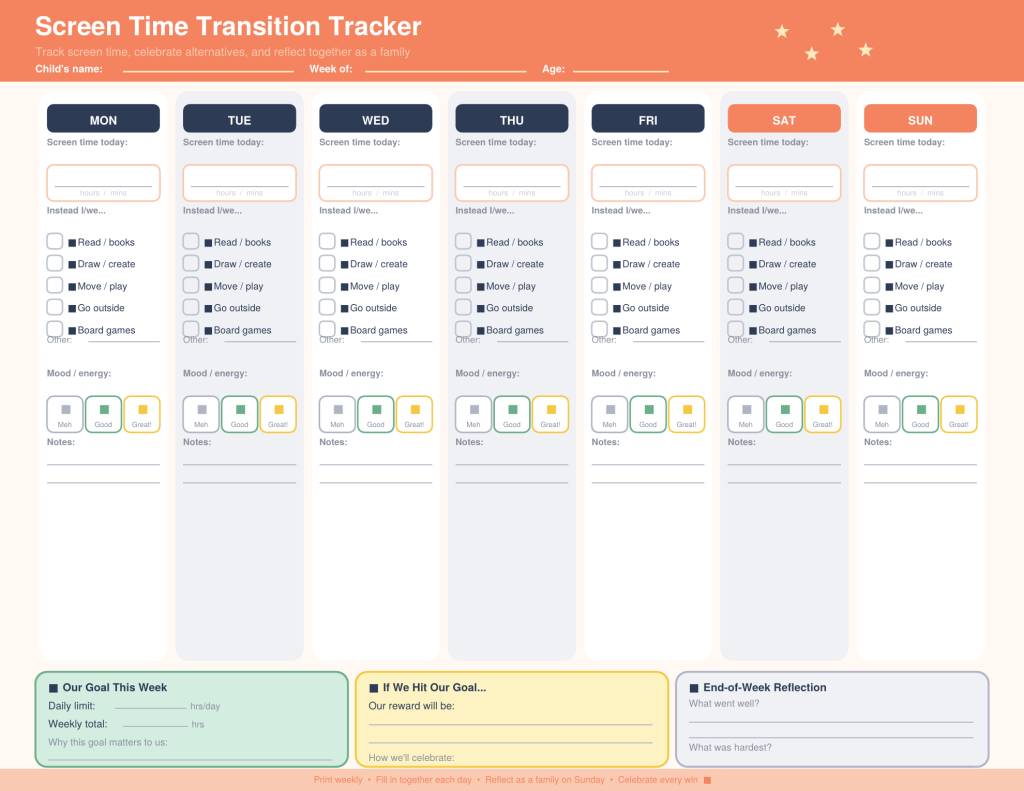
    Tracking progress makes the transition stick. Use this free weekly tracker to log screen time, celebrate the alternatives your child chooses, and reflect together at the end of the week — it takes less than two minutes a day to fill in.

    Troubleshooting: What to Do When Play “Fails”

    Building stamina is like training for a marathon. Your child might only give you 5 minutes at first. That is a victory.

    The “One-Minute” Energy Discharge

    If you set up a station and your child immediately walks away to cling to your leg, they likely have a “Stress Response” stuck in their body. Before trying again, do a “One-Minute Shake-Off.” Have a dance party, do ten jumping jacks, or have a “pillow push” contest. Discharge the restless energy physically, then re-introduce the sensory task. You’ll find they are much more likely to settle once the “speedy” energy is out of their system.

    The Cognitive Benefits of Boredom

    We live in a culture that fears boredom. But for a child, boredom is the “waiting room” for creativity. When we immediately hand over a tablet the moment a child says “I’m bored,” we are stealing their opportunity to problem-solve.

    By choosing the Independent Play Blueprint, you are teaching your child how to be comfortable in their own company. You are teaching them that they have the internal resources to entertain themselves. This isn’t just about you getting the laundry done—it’s about raising a resilient, self-soothing human being.

    Conclusion: Becoming a “Cycle Breaker”

    Reclaiming your productivity doesn’t require you to be a “Super Mom” who entertains her kids 24/7. It simply requires a shift in the environment and a deeper understanding of your child’s biological needs.

    By utilizing sensory stations that anchor a child in the “now,” you provide the internal stability they need to stay focused and calm. You are choosing engagement over passive distraction. Start small tomorrow. Pick one chore, set up one sensory anchor, and practice the “regulate first” approach. You’ll be surprised how much you can get done when your child is engaged with the world around them instead of a digital display.


  • Morning Reset: Before the Kids Wake Up

    Morning Reset: Before the Kids Wake Up

    In the quiet, pre-dawn moments of a modern household, there is often a hidden, high-stakes biological event occurring: the morning cortisol spike. For many moms, the day doesn’t begin with a gentle awakening; it begins with a physical jolt—a mental to-do list that hits like a freight train the second the first floorboard creaks in the hallway. This isn’t just “morning grogginess”; it is your nervous system shifting immediately into a state of high alert. Before you have even reached for your coffee, your body may already be in a state of sympathetic nervous system activation—the “fight or flight” response—preparing you for a day of demands, sensory overload, and emotional labor.

    The challenge of modern motherhood is that we are often expected to be the “calm center” of our homes while our own internal systems are red-lining. We hear the term “self-care” and imagine spa days or solo vacations, but for a parent in the thick of it, those are often unattainable luxuries. True, sustainable self-care isn’t about escaping your life; it’s about regulating your biology so you can inhabit your life without feeling constantly frayed. By focusing on nervous system regulation—the literal calming of your vagus nerve and the lowering of your heart rate—you move from a state of reactive “survival mode” to a state of responsive “thriving mode.”

    The beauty of nervous system work is that it doesn’t require an hour of silence or a yoga studio. Your body is a programmable biological machine, and you can send it “safety signals” in as little as sixty seconds. When you prioritize regulating your own system first, you aren’t just helping yourself; you are co-regulating your children. Kids, especially young ones, mirror the nervous systems of their primary caregivers. If you are vibrating with frantic energy, they will likely match it. By taking five minutes to anchor yourself before the chaos begins, you are essentially setting the “emotional thermostat” for your entire home.

    The Foundation: The “Night-Before” Setup

    To make a 5-minute morning reset successful, you must lower the “barrier to entry” the night before. Nervous system regulation is difficult when you are met with physical clutter or immediate “emergency” tasks like finding matching socks. Spend ten minutes before bed clearing one flat surface (like the kitchen counter) and setting out your journal or a glass of water. By removing these micro-stressors, you give your brain permission to stay in a “rest and digest” state for those precious few minutes after you wake up.


    7 Tiny Habits to Regulate Your Nervous System

    To move from chaos to calm, try integrating these seven evidence-based “soothers” into your morning. These are designed to be done in the kitchen, the bathroom, or even while standing at the top of the stairs.

    • 1. The Cold Splash Reset If you feel that immediate “buzz” of anxiety upon waking, use the mammalian dive reflex to your advantage. Splash ice-cold water on your face or run your wrists under a cold tap for 30 seconds. This sudden temperature shift sends an immediate signal to your brain to lower your heart rate and activate the parasympathetic nervous system, effectively “rebooting” your stress response. It is the biological equivalent of hitting the “reset” button on a lagging computer.
    • 2. 4-4-4-4 Box Breathing Breathwork is the fastest manual override for your nervous system. Inhale for a count of 4, hold for 4, exhale for 4, and hold the empty space for 4. This rhythmic pattern balances oxygen and carbon dioxide levels in the blood, signaling to your amygdala—the brain’s fear center—that there is no immediate threat. This allows your “logical brain” to come back online before the kids start asking for breakfast.
    • 3. Barefoot Grounding (Earthing) If possible, step outside onto the grass or soil for two minutes; if not, simply stand barefoot on a hard floor and focus entirely on the sensation of your feet connecting with the ground. This practice, often called “earthing,” helps shift your awareness from the “mental world” of stressors and schedules back into the physical world. It reminds your body that you are physically supported and safe in this exact moment.
    • 4. The Hand-on-Heart Affirmation Physical touch releases oxytocin, the “bonding hormone,” which naturally counters cortisol. Place one or both hands over your heart, feel the warmth, and repeat a grounding mantra: “I am safe. I am doing my best. I deserve love.” Continue this until the words begin to feel true. This isn’t just “positive thinking”; it is a physiological shift that moves you from self-criticism into self-compassion.
    • 5. The 5-4-3-2-1 Sensory Anchor When the mental “noise” becomes too loud, use your senses to return to the present. Identify 5 things you see, 4 things you can touch, 3 things you hear, 2 things you can smell, and 1 thing you can taste. This grounding method is a powerful tool during sensory or emotional overload, pulling your brain out of a “worry loop” and back into the “now.” It forces your brain to process external data rather than internal anxiety.
    • 6. The 3-Minute “Brain Dump” Journal Stress often stems from the feeling that we might forget something important. Spend three minutes writing down every worry, task, or frustration onto paper. Your stress doesn’t make you a bad mom—it makes you human. Getting these thoughts out of your head and onto the page reduces the “cognitive load” your nervous system has to carry. Once it’s on paper, your brain no longer has to use energy to “loop” that information.
    • 7. Strategic Movement (The Vagus Nerve Shake) Animals in the wild literally “shake off” stress after a close encounter with a predator. You can do the same. Spend one minute gently shaking your arms and legs or dancing to one high-energy song. This physical release helps “discharge” the pent-up energy of a stress response. It ensures you don’t carry that “tight” physical tension into your first interaction with your children.

    What If the Kids Wake Up Early?

    The “Pinterest-perfect” morning involves a sunrise and a quiet house, but reality often involves a toddler waking up at 5:30 AM. If your 5-minute window is invaded, do not abandon the practice—narrate it. Tell your child: “Mommy is feeling a little bit ‘speedy’ in her heart, so I’m going to take three big box breaths so I can be a calm mommy for you.” By doing this, you aren’t just regulating yourself; you are modeling emotional intelligence. You are showing them that big feelings aren’t scary—they are something we can manage with our breath and our bodies. This is the essence of “Cycle Breaking”: teaching the next generation a better way to handle the human experience of stress.

    Implementing these small shifts is about more than just “feeling better” in the moment; it is about the long-term work of becoming a “cycle breaker.” A cycle breaker is someone who recognizes the patterns of stress and reactivity they may have grown up with and chooses to respond differently. By choosing to “regulate first and react later,” you are teaching your children that emotions are manageable and that safety starts from within. This practice transforms your morning from a gauntlet to be survived into a foundation for a more intentional, peaceful life.

    Conclusion

    You don’t need a perfect life to have a calm nervous system; you simply need a few tools to help you navigate the life you have. By dedicating just five minutes to these “soothers,” you reclaim your agency over your biological response to stress. Remember, you aren’t failing if you feel overwhelmed—you are simply experiencing a human reaction to a demanding role. Start small tomorrow morning: splash some cold water, take a deep breath, and remind yourself that you’ve got this. You are doing the hard work of staying present, one breath at a time. The world doesn’t need a perfect mom; it needs a regulated one.