

The quiet symptoms no one talks about — irritability, emotional numbness, resentment.
You’re functioning. The kids are fed, the laundry’s (mostly) done, and you’re showing up to work or playdates or school drop-off with a smile that feels automatic rather than genuine. From the outside, everything looks fine.
But inside? Something feels… off.
You can’t quite name it. You’re not sad exactly. You’re not sick. But you’re not yourself either. You snap at your partner over tiny things. You feel annoyed when your child wants to cuddle. You catch yourself scrolling your phone while your family watches a movie, feeling strangely disconnected from the warmth happening right next to you.
If this resonates, pause here for a moment. What you’re experiencing might not be a character flaw or a bad mood. It might be mom burnout wearing a disguise.
Let’s talk about the subtle signs—the ones that creep in quietly and convince you that nothing is really wrong, even when everything feels heavy.
What Mom Burnout Really Looks Like
When we hear “burnout,” we often picture someone collapsing in tears or unable to get out of bed. And yes, motherhood burnout can look like that. But more often, it looks like you on an ordinary Tuesday—going through the motions, meeting everyone’s needs, while slowly losing connection to yourself.
Burnout isn’t just exhaustion. It’s a state of physical, emotional, and mental depletion caused by prolonged stress without adequate support. For moms, this builds slowly—layered over months or even years of putting everyone else first.
The challenge? The early warning signs are easy to dismiss. They masquerade as personality quirks, temporary moods, or just “how motherhood feels.”
Let’s pull back the curtain on seven subtle signs that deserve your attention.
The Difference Between Normal Exhaustion and Burnout
Before we dive into the signs, let’s clarify one important distinction:
Normal exhaustion feels like tiredness after a long day. A good night’s sleep helps. A glass of wine with a friend helps. A partner taking over bedtime helps.
Mom burnout doesn’t respond to those bandaids. Sleep doesn’t fix it. Time alone doesn’t fix it. You carry a weight that rest doesn’t lift because the weight isn’t just physical—it’s emotional and psychological.
Burnout is what happens when you’ve been running on empty for so long that your tank is now cracked. Even when you try to refill, nothing quite sticks.
The 7 Subtle Signs of Mom Burnout
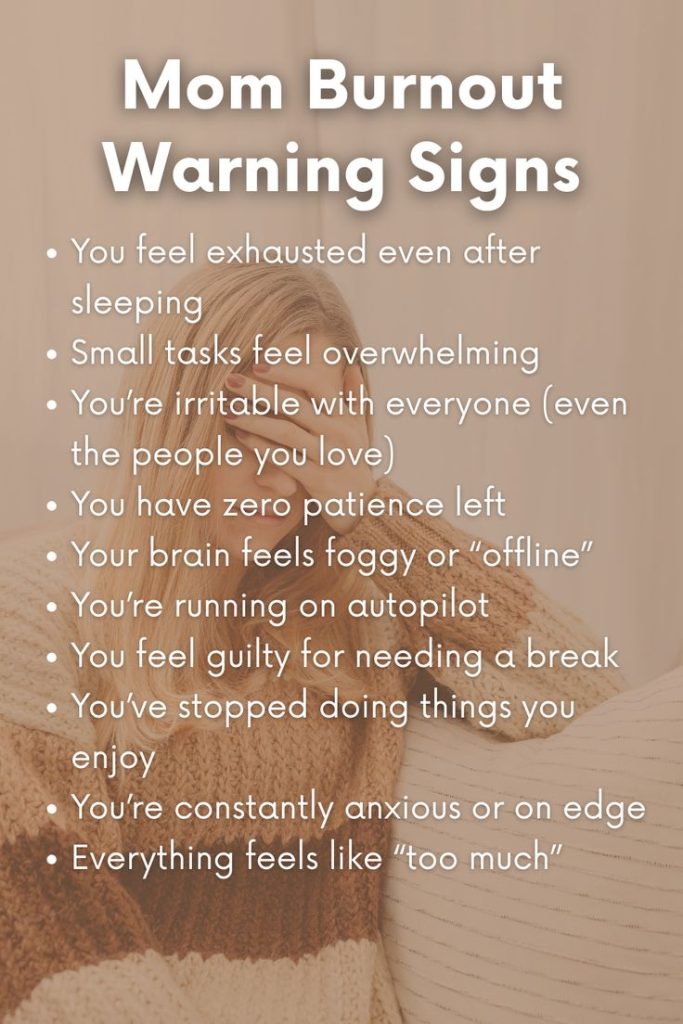
1. Irritability That Feels Out of Character
You used to be patient. Now every little thing gets under your skin. The way your partner chews. The sound of Paw Patrol for the thousandth time. A question asked while you’re mid-task.
What it looks like: You snap at your child for spilling milk—not because spilled milk is a big deal, but because it’s the 47th thing you’ve had to handle today and your nervous system is screaming.
Why it’s easy to miss: You tell yourself you’re just stressed or tired. Everyone gets cranky sometimes, right?
What helps: Notice the pattern. Irritability that’s chronic and disproportionate to the trigger is a signal, not a personality flaw. Your nervous system needs rest, not judgment.
2. Emotional Numbness or Detachment
This one’s scary because it feels like you’re becoming cold. You go through the motions of motherhood—hugs, bedtime stories, “I love you’s”—but you don’t feel the warmth you expect to feel.
What it looks like: Your child runs to you with arms open and you hug them automatically while thinking about the grocery list. You feel disconnected from the joy you know should be there.
Why it’s easy to miss: You’re still showing up. You’re still doing the tasks. You tell yourself the feelings will return when things calm down.
What helps: Emotional numbness is often your brain’s way of protecting you from overwhelm. It’s not who you are—it’s a symptom. Gentle self-compassion matters here. Your feelings aren’t broken; they’re buried.

3. Resentment Toward Your Partner or Kids
You love your family fiercely. So why do you feel a twinge of bitterness when your partner relaxes on the couch? Why do you feel annoyed when your kids need something else from you?
What it looks like: Keeping a mental scorecard of everything you do versus everyone else. Feeling angry that no one notices how much you’re carrying. Thinking, “Must be nice,” when someone else rests.
Why it’s easy to miss: Resentment feels ugly, so we push it down. We tell ourselves we’re being ungrateful or unreasonable. But resentment is actually useful information—it’s pointing to an imbalance that needs attention.
What helps: Instead of judging the resentment, get curious about it. What need isn’t being met? What boundary needs reinforcing? Resentment is your inner wisdom waving a red flag.
4. Forgetting Things More Often Than Usual
You’ve always been the one who remembers everything—birthdays, permission slips, when the toilet paper is running low. Lately, things slip through the cracks.
What it looks like: Walking into a room and forgetting why. Missing appointments you usually remember. Drawing a blank on common words mid-sentence.
Why it’s easy to miss: You blame lack of sleep or “mom brain” and assume it’s normal. But chronic stress actually changes brain function—it affects memory, focus, and cognitive processing.
What helps: This isn’t permanent. As your nervous system regulates, your cognitive function returns. For now, write everything down without shame. Your brain is protecting you, not failing you.

5. Feeling Like You’re Watching Yourself From Outside Your Body
Have you ever had moments where you feel almost robotic—going through motions, hearing yourself speak, but feeling strangely disconnected from your own life?
What it looks like: Driving home and realizing you don’t remember the last ten minutes. Sitting at the dinner table feeling like you’re observing your family from a distance rather than participating.
Why it’s easy to miss: We call this “being on autopilot” and treat it as normal. But chronic depersonalization is often your brain’s way of creating distance from overwhelming stress.
What helps: This is your nervous system saying, “This is too much.” Grounding techniques—five things you can see, four you can touch, three you can hear—can help gently return you to your body.
6. Losing Interest in Things You Used to Enjoy
Remember hobbies? Interests? Things you did before kids that lit you up inside? When was the last time you felt genuinely excited about something just for you?
What it looks like: Friends invite you out and you feel dread instead of anticipation. Your favorite book sits untouched. You scroll instead of creating, watching instead of doing.
Why it’s easy to miss: You tell yourself you’re just in a different season. There’s no time for hobbies anymore. This is just how motherhood is.
What helps: Loss of interest in things you once loved (anhedonia) is a hallmark of both burnout and depression. It matters. Start tiny—five minutes with a book, listening to music you used to love. Reconnect in small doses.

7. Feeling Like Nothing You Do Is Good Enough
Perfectionism often intensifies during burnout. You try harder, do more, push longer—hoping that if you can just get everything right, the overwhelm will lift.
What it looks like: Lying in bed mentally reviewing everything you “should have” done differently. Feeling like you’re failing no matter how hard you try. Comparing yourself to moms who seem to have it together.
Why it’s easy to miss: Society praises moms who push through exhaustion. We’re conditioned to believe that if we feel like we’re failing, we must need to try harder.
What helps: Here’s the truth: You’re not failing. You’re running a race with no finish line, carrying weights no one sees. The problem isn’t you—it’s the impossible expectations. Lower the bar. Seriously. Good enough is actually wonderful.
Why These Signs Are Often Ignored

We ignore these subtle signs for understandable reasons.
First, survival mode. When you’re in crisis mode just getting through each day, you don’t have the bandwidth to notice or name what’s happening internally. You just keep moving.
Second, comparison. You look around and see other moms functioning. If they’re okay, you must be okay too, right? But here’s what you don’t see—their exhaustion, their numbness, their hidden struggles. You’re not alone in this.
Third, guilt. Naming burnout feels like admitting failure. But naming it isn’t failure—it’s the first step toward recovery. You can’t heal what you won’t acknowledge.
Small First Steps Toward Recovery
If you recognized yourself in these signs, take a breath. You’re not broken. You’re not a bad mom. You’re a human being who has been running on empty for too long.
Here are three small, gentle steps to begin moving toward recovery:
1. Name it out loud. Tell someone you trust: “I think I might be experiencing burnout.” Saying it breaks the isolation and makes it real in a way that allows you to address it.
2. Remove one thing. Look at your plate and remove one non-essential responsibility—just for this week. Let something go and don’t replace it. Practice letting it be undone.
3. Ask for one specific thing. Identify one concrete need and ask someone to meet it. “Could you pick up milk?” “Would you handle bedtime tonight?” “I need 15 minutes alone.” Start small. You deserve support.
You Deserve to Feel Like Yourself Again

Mama, here’s what I want you to carry with you: These subtle signs aren’t character flaws. They’re not signs that you’re failing. They’re signals—your mind and body telling you that something needs to shift.
Mom burnout is real, and it’s treatable. You don’t have to live in this disconnected, irritable, exhausted fog forever. Small steps, consistent support, and permission to put yourself on the list too—these things add up.
You are still in there. The version of you who laughs easily, rests deeply, and feels connected to yourself and your family—she’s not gone. She’s just buried under too much weight.
And slowly, gently, you can begin to lighten the load.
You deserve that. Not because you’ve earned it. Not because you’ve done enough. Simply because you exist, and you matter—outside of everything you do for everyone else.
Start where you are. Use what you have. Do what you can. And remember: you’re not alone in this, not for one single moment.
Leave a Reply